Wednesday, March 11, 2015
Buying a Custom Made Dresch Saddle
In October 2014 I was taking two weeks worth of lessons at Sunflower Farm from Amanda Johnson and was lucky enough to be there when Sebastian Dresch was there working on saddles. I was riding Bacara in a lesson and he was waiting for Amanda to finish and watched Bacara moving. He told Amanda that I needed to resolve my saddle fitting issues. Amanda mentioned that I may want to let Sebastian look at Bacara and give advice on saddle fit.
Ugg - dressage is expensive and I was a little worried but thought I should hear what Sebastian had to say. He told me that her shoulders sloped back well but the saddle was getting in the way of her using them and that her 18th rib was fairly straight up and down and that made for a rather small comfortable spot for the saddle to sit. I am 5'10" tall so I need an 18" seat.
I decided to go ahead and order a saddle as I really want to ride FEI and know Bacara needs to be very comfortable to do that. I was hoping the saddle would make enough of a difference that she wanted to try really hard for me.
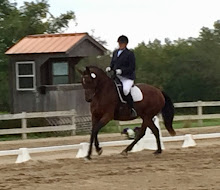
The saddle was delivered and the thigh blocks were added. It was so very strange riding around because my leg laid down directly under me and I could feel so much more than I used to be able to feel. The amount of feel that I had was so much more that it was a little overwhelming at first. I have been riding in the saddle for about 2 weeks now and I am appreciating all of the added rider feel. Bacara loves it too. Bacara is so much more relaxed and happy in her work - now I am wondering what I did without the saddle!
Thank you Amanda!
Thank you Sebastian! What an honor to ride in one of your saddles!

Tuesday, November 11, 2014
It's All about the Brace - No Trouble
I had the pleasure of spending October 14th through October 24th at Sunflower Farm in Bristol, WI studying dressage with Amanda Johnson. This opportunity was so helpful to my riding I thought I would try to explain it a little.
The underlying theme for both Hazel and Bacara was to eliminate bracing in any way shape or form and then there would not be balance problems. So I started in my head to think progressing was all about the brace, if I did not have it, I would have no trouble with the horse.
Hazel is a muscular horse that needs to work on flexibility. We worked on Shoulder-In developing, Haunches in Developing and Renvers Developing. We did all of these movements and then took two steps off the wall and then moved back to the wall while keeping the original position. This really loosened the horse and increased her ability to step under and across better. Amanda said that I should not do this every day - so I have been alternating this exercise with shoulder-in to lengthen within the shoulder-in; haunches-in to lengthen within the haunches-in and Renvers to lengthen within renvers. This seemed to increase the ability of Hazel to have more longitudinal reach. These exercises are proving to help her in a very huge way.
Bacara is a flexible horse that seems to have a few stuck spots and sometimes does things in a less than straight and through fashion. We really did focus a lot on improving her throughness and straightness. The shoulder-in to renvers proved to be very valuable. She really is tighter on her right side that her left. This really does help even things out quite a bit. I am thinking her saddle is contributing to this some as when I used a pad that Amanda lent me to help the saddle not pressure her shoulder bulbs, she had an easier time right away.
I came to understand that I would have better downward transitions and balancing transitions if I used my seat way lower to ask for them. To me it felt like just above my ball joints in my hip area. I am not sure that is the correct term but I do know that the horse seems less able to brace the lower in your seat you are able to ask.
Bacara and I have been working very hard to have really nice straight and through flying changes. I have found shoulder-in in the counter canter to renvers in the counter canter to straight and repeat really improves her collection and throughness. When this is easy for her and she is not bracing, the flying changes are easy for her. I am thinking I was just not picky enough on the canter quality. I have said this before and have thought this before that lateral looseness helps the collection and throughness but this practical application in the canter is extremely helpful! I think it was my mistake on understanding how much I could improve the canter. I feel like I have a better understanding on canter development now. Thank you Amanda!
McKayla Hohmann came with me for the first week. She had the chance to take several lessons in a row on Hazel and came away with a better understanding on how much collection would be needed for FEI Pony tests. They worked on lateral loosening as well. We hope to make great strides over the winter with this pair!
The opportunity to just focus on quality improvement without distractions really does make a difference and is a huge gift!
Monday, July 21, 2014
Finding the balance for my horse through better understanding of neck position - Amy Larson Clinic
You know I had always thought I was o.k. on balance if my horse was evenly bent but not over bent in any one spot. I am thinking that the neck has to be more centered than I once thought. I am thinking that the neck flex is a big deal - when I say that I mean where the neck flexes. It has come to my attention (through a very effective lesson with Amy Larson) that longitudinal balance has to do with where the neck flexes.
I had the pleasure to experience a light feel with my mare Bacara as a result of positioning her neck in the center with the flexion up high near the axis of her neck. I thought she was just not light enough so I would push her stronger forward into a half halt. But I can say as soon as I adjusted her neck position and where her neck flexed she became light and we had very little trouble with longitudinal lightness. . .oh my many of the other issues I have been having - crooked changes, unsteady in the bridle, slightly behind my leg seem to be all related to this issue.
Yikes!!! Alignment, Alignment, Alignment!!!
Thank you Amy - I appreciate your help!
Wednesday, June 18, 2014
Amanda Johnson Clinic - June 2014 - Bacara
Amanda Johnson was teaching in Western Wisconsin again on June 14th and 15th. I had done my homework with my mare Bacara and had made sure our canter was somewhat better then it was at the last clinic. I took the time to work on shoulder in, shoulder in with a counter bend, haunches in and haunches in with a counter bend on a 15 meter circle. I was able to have way more ability to adjust the canter. That was really helpful coming into this clinic.
The biggest difference in this clinic was that it was away from home which allowed Amanda to see what my horse was like at a horse show. She is way higher in her energy. So with that going on - we came up with a different approach to warming her up and ultimately riding her.
On the first day we really focused on honestly aligning her and not losing her shoulders to the left in the trot. We rode from quarterline to quarterline working out shoulder placement. When traveling to the right, what helped the most was shoulder-in to Renvers to Shoulder in and back again. This really aligned her body and allowed throughness and collection to take place. But when traveling to the left it was better solved by haunches in to shoulder in and back again. This trot work set us up for success in the canter.
On the second day of the clinic - we started after our initial stretching, in the canter. With no trot work first she almost reared into the canter. (She does have a fair amount of stress away from home.) Amanda told me that we were going to alternate between collection and stretching her into a longer frame to warm her up. Well we did all sorts of things in that way. We did 20 meter circles 10 meter circles, half pass all with varying lengths in her neck. This calmed her down more effectively than anything I have ever come up with. So I am thinking this is a great way to ride the canter on this horse for now. In the past I had always stretched her out in the canter at the start of the ride but had never blended it like that before. I think that when she is a finished horse she will be able to come up and stay up and do all of her canter work. I guess it does not really matter if it is a strength issue now or a mental block for her. The blending sure makes a huge positive difference!
The other really loud thing was I have always done my flying changes 1/2 halt, 1/2 halt and then a change request instead of a third 1/2 halt. Hmmmm crooked or on the forehand or late. . .I stand corrected the proper sequence is 1/2 halt, 1/2 halt and change. The change request is immediately following the second half halt. Yikes. . .all of these years I have not been asking at the right time. . .sigh but the good news is I was able to get the best straightest changes out of Bacara! You have to love that. She is so sensitive she tells on me every time!
I did give Bacara a few days off and did play with this again on my own. I did have a little drama as she is so smart she started to think two half halts in the canter must mean change. . .I had to go random on her and do the collected canter, stretchy canter and collected canter and then I could slip in a really nice good clean change that did not get light in front or backed off in any way. But this playing with the canter frame and balance is truly going to be homework for both of us as we feel our way through it.
We also did quite a bit of work on 1/2 steps on the second day. Bacara seems to have a natural ability in this area. I figured out that it is best to approach at least for now from the trot. She comes into the 1/2 steps really well if she is honestly in front of my leg. If she is at all behind my leg, she will be irregular in the 1/2 steps.
It looks like I have new homework this month but I am looking forward to playing with everything I have learned this past weekend.
Wednesday, May 14, 2014
April 2014 Amanda Johnson Clinic
It is always interesting to taking lessons from others and begin to understand their ideas and add them to what you already know. Amanda Johnson was no exception.
With lower level horses, it was common to place them on a 20 meter circle and then do a turn on the forhand (a complete 360 degrees) and then back to the 20 meter circle. This really helped the young horses move better and had them bringing their inside hind leg up under and more engaged right away. This movement was very effective and easy for the young horses to understand right away.
If you were riding a more advanced horse your warm-up was more likely to have a mix of shoulder for on the 20 meter circle to medium trot to shoulder for and repeat. This was a very powerful way to engage and loosen your horse. The horse used collection muscles briefly and then extension muscles breifly and the end result was a better moving horse fairly quickly. We all like this warm-up a lot!
Another concept that was new for me was with horses that brace or get heavy in the bridle. Amanda said to juggle or basically systematically raise one hand and lower it as you raise the other and continue in that fashion. I rode a Lipizzan mare with this and it worked really well. She became softer in the bridle than ever before. I am thinking that there is just nothing for them to brace and lock into. This is very different than a lateral see saw, it is a slow longitudinal random rein that is hard for the horse to brace against.
Then specifically I worked on canter improvement on my advanced mare. We have been doing changes for a while now and my biggest quality hole is that she get too crooked during the changes. We worked on a 15 meter circle doing shoulder for, shoulder for in counter bend, haunches in, haunches in with a counter bend. As a rider I am thinking it would be easier to do a canter pirouette.
But I think the object of the game was to improve my ability to laterally adjust my horse without having an accidental flying change. I have been working on haunches in with a counter bend to a flying change. The changes from left to right are getting really good. The changes from right to left are still a little crooked but I can feel the position essentially blocking the crookedness. So I am finding this really effective in showing my mare how to be straighter during her changes.
I look forward to the next Amanda Johnson clinic for more clarification and refinement. These clinics sure do make a difference us as we plan our training.
Tuesday, February 4, 2014
Blending Torso, Leg and Rein aids for improving your horse's movement
Strategies for mixing torso, rein and leg aids to add volume to a horse’s movement.
When we, as riders, think about how to mix torso, rein and leg aid, the subject can seem overwhelming.
Here are some simple ideas on how to mix these aids:
The rider can come in with his/her torso tight and just hold it while half halting with the outside rein and pushing with the legs within the timing (not half halting for more than one beat). This helps a great deal to not get the horse locked in its neck or back. This applies to the walk and trot. But riders must remember to release their torso as the horse responds correctly to the half halts. As the horse improves its balance as a result of the half halt, the rider should loosen her/his torso for a reward. This works well for the walk and trot.
For the canter, the rider should hold only as the horse swings the rider’s hips forward and release as the horse swings the hips backwards. This helps the horse balance better without constricting it. This is in addition to alignment not instead of it. Relative straightness in the canter will allow your horse to have an uphill canter.
Over many years I have worked with many horses that are not warmbloods. These horses tend to need help in freedom of movement and collection both. As a result I have tried like crazy to aid them in the best possible timing and then release, and then aid them in the best possible timing and release . This builds their freedom in movement and then I ask for better balance and collection.
The rider needs flexion in the horse to one side or the other to define an outside rein. The half halt then comes through really well on the rein that is opposite of the bend.
This is required to a lesser degree on the loose moving warmbloods . They tend to really need more balancing then they need loosening. The rider will need their core engaged more to help them with their balance. I say this because if a rider has ridden mostly loose moving warmbloods, they are going to wonder what I am talking about.
For example, I have been working on piaffe on one horse for 6 - 9 months. She tends to stress. In the past she has sometimes stressed out and I would release her from the movement and try again. Now she is mature enough in her thoughts about Piaffe that last week when I approached it and she stressed out, I just stayed in the Piaffe request until she found her way there. This horse is an example of a loose moving warmblood. She was stressing and worrying about the balancing aid. She really needs the longitudinal balance help more than she needs help loosening her gait.
The approach to non- warmbloods is for me very different because they need to maximize their movement before they can be collected. When riding a loose moving warmblood, I can almost at the same time ask for more movement and better balance, but that would not work on a horse that had tighter movement. For a horse with tighter movement it is a step by step process.
I really enjoy loosening tight horses and then have the riders elevate them into collection.
Monday, December 9, 2013
2013 USDF Annual Convention - December 4th through December 8th.
The Annual Convention was located in Lexingto KY this year, right in the middle of horse country. December can be a little tricky and this early December was no exception. We left Wisconsin a day early to drive out of a storm and left Lexington Saturday evening instead of Sunday to avoid an ice storm. The convention was great - driving conditions were fair to poor.
The Board of Governers was really not overwhelmed with decision making. The only contested office that needed to be voted upon was Secretary of the Board for USDF. Margaret Freeman was elected to this position. She has a masters degree in journalism, an excellent choice. Lisa Gorretta, from region 2, ran unopposed for the position of Vice President.
The USDF is very proud of the National championship show that was held in Lexington this year. Next year the championships are scheduled to be at Gladstone.
There was a fair amount of talk about Intermediare being changed from 1 and 2 to A and B. This was done to make the steps towards grand Prix more gradual.
Some of the educational classes that I had time to attend were Degenerative Joint Diseas, Equine Rehabilitation and Preventative care, Schleese Saddle fit for life, colic and equine emergencies, and gastro intestinal health in the equine athlete. There were some ey opening facts in each session.
Degenerative Joint Disease and Equine Rehabilitation to me seemed fairly linked. It seems that giving Adequan every four days for 7 injections, was a helpful thing to do for your equine athlete. It really was one of those preventative options that can help your horse's joints long term. Adequan and Legend are the only FDA approved drugs that we have available for prevention and repair. Feeding joint supplements can help, but their absorbtion rate is quite a bit lower.
Shoeing and soundness were talked about as well. Someone asked about shoeing versus natural farrier trimming. The response was that it really depended on the ground you were working on. Some areas of the country were so rocky, that it would be hard to make the natural trimming work well even if it was done very well. The other statement was that the natural trimmer would have to trim the hoof once every 3 weeks and the owner could not rely on the natural wear pattern of the horse. That being said, may folks who show dressage ride their horses often enough and long enough that added support is frequently needed.
The training recommendation that was talked about was giving breaks during the training sessions. Allowing the joints to recover before moving on, is beneficial to your horse's joint health.
The Schleese saddle fitting classes were also interesting. Jochen Schleese talked about the different saddles needed for men and women. He showed a the difference in how the femur was tied into the pelvis and why the difference was needed. He stated that girls or women needed a narrower twist and a wider seat to be comfortable and secure in the saddle. The placement of the stirrup bars also needed to be adjusted. Jochen stated that lower back pain and pelvis pain are associated with women riding in saddles made for men.
Equine nutrition was also discussed and we talked about what kind of oil was best to use on feeds. Soybean Oil was the best option for oil that the horse would like the taste. Apparently, fish oil was even better but the horses are not liking the taste. The University of KY was playing with flavoring the fish oil with Cherry to make it easier for the horses to get used to. Oil decisions were made on which oils had more omega 3 verses omega 6 fats in them. The higher the ratio of Omega 3 the better.
When talking about horse feeds, the issue of insulin resistant horses came up. Those horses are fed a low carb diet to keep the sugar to a minimum to avoid founder issues. The other specialty group seemed to be the horses that tie up. Those horses also did better on high fat feeds. Also horses with ulcer symptoms seemed to do better on higher fats feeds as well. There is a lot of research going on right now about which feeds should be fed to which horses. Feeding your horses for peak performance is going to be an interesting field to watch.
The awards banquet on Saturday night was really nice. It is fun to see people doing well at all levels. This year I was there to pick up a bronze Freestyle Bar for the freestyles that I have ridden on Hazel and Bacara. The amount of equine knowledge in the room was very inspiring. One of the people that sat at our table was a trainer from California that trained at two farms, one for Hilda Gurney (trakehners), and then for a morgan breeding farm. I took the opportunity to talk with him about flying changes for horses with rounder more baroque bodies (like the Morgans). He shared with me some excersises that he likes for their body types. You never know where you will pick up more ideas!
If you would like to talk about any of these things in detail, let me know. I took many photos of the slides!
Thank you WWDA for sedning me to this conference as your GMO Rep!
Subscribe to:
Posts (Atom)