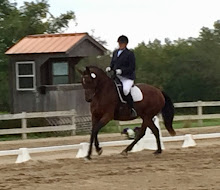
This weekend I took two horses to a Lientje Schueler clinic in Elk Mound, WI. Both horses are advanced enough to work on collected work. When asked what I wanted to work on while I was riding my first horse Bacara, I said I wanted to work on the quality of her canter. I stated that she had a good canter but when I collected it she left her back tense and lifted her neck. I needed a solution for canter collection that included her entire top line.
The first thing we did was work at the walk and trot to straighten the horse we counter bent her a little and pushed her haunches out to align her. Then we moved on to the canter and did the same. This really made a difference in her top line right away. She was already coming up a little better.
After the canter was straight we widened the reins and pushed her into collection. It seems that the horse was getting stuck in her lower neck and if I widened and lowered my reins a bit - I was able to collect her without her getting stuck there. When I say getting stuck there I really mean that she needed to lower her neck a little in front of her withers (to make the top line a continuous arc) and then lower her croup to obtain the canter collection. The difference in the canter collection and Bacara's ability to stay relaxed was super. I have a direction to go with her that will only make her more athletic in the canter.
Hazel was my other horse at this clinic. We did a very unique exercise. My most stuck spot on Hazel seems to be that she does not displace her ribcage very well. Especially to the Right. Hazel will swing her haunches slightly right or left to avoid bending in her ribcage. She is short coupled and muscular - so this is hard for her. The exercise that was unique was that I had a lung line attached to my riding boot. This was instant feedback if Hazel was trotting or cantering on a circle and she slid her haunches one way or another. Keeping a steady soft tension on the line was really quite difficult. I laughed and said the line tugging on my boot reminded me of a dog getting zapped with a shock collar when it went beyond its boundary. This was really quite effective for improving the bend and not letting the haunches drift.
An additional comment I have is that in the canter, if Hazel was at all stuck in her lower neck, widening and lowering my hands for a moment really helped a lot and her canter collection improved immediately.
Sunday, October 21, 2012

Monday, August 27, 2012
Friendly Game Gone Bad!
I had a unique experience to participate in a trainers challenge. What happened were that there were over 20 horses to be trained. Each trainer was assigned a horse to train and had about 140 days to do so.
Well the big day came and the people there were really quite into the western riding style so I of course was not a crowd favorite as a dressage rider. But the experience was fun none the less.
I have called this blog the friendly game gone bad but it could also be called desensitizing your horse gone bad. The winners of this challenge were of the reining persuasion with a bit of natural horsemanship thrown in. Let me say that I think the reserve champion should have won and I am going to tell you why.
The winner did a basic reining freestyle with a his horse getting on a pedestal at the end. His horse fell off from the pedestal and he basically fell off his horse at the same time. He pulled out a bull whip and cracked it repeatedly with rage. His horse cowered but stood still. I was pretty shocked and so were many of the women who witnessed this. This is by the very definition - not a good thing.
I do believe that helping your horse deal with random noises and random things does help them become more solid and not take things so personally. They start to understand that not everything is meant for them. If you have a particularly sensitive horse, you must start this desensitizing quietly and build trust and confidence from there. Once this is established you can increase to a more extreme type of desensitization for your horse. You know if you have over faced your horse if his eyes go dead or if he cowers. But for me I watch for sweating or increased heart rate and never go past that point. This is the fastest way to teach and build trust at the same time. Teaching must come before enforcement. If the trainer enforces before the teaching is complete - you decrease the trust which is something you really do not want to do.
I say this as the rider who placed first in the trail class at the trainers challenge. My horse trusted me completely. My techniques are a mix of natural horsemanship and Dressage (heavy on the dressage).
Well the big day came and the people there were really quite into the western riding style so I of course was not a crowd favorite as a dressage rider. But the experience was fun none the less.
I have called this blog the friendly game gone bad but it could also be called desensitizing your horse gone bad. The winners of this challenge were of the reining persuasion with a bit of natural horsemanship thrown in. Let me say that I think the reserve champion should have won and I am going to tell you why.
The winner did a basic reining freestyle with a his horse getting on a pedestal at the end. His horse fell off from the pedestal and he basically fell off his horse at the same time. He pulled out a bull whip and cracked it repeatedly with rage. His horse cowered but stood still. I was pretty shocked and so were many of the women who witnessed this. This is by the very definition - not a good thing.
I do believe that helping your horse deal with random noises and random things does help them become more solid and not take things so personally. They start to understand that not everything is meant for them. If you have a particularly sensitive horse, you must start this desensitizing quietly and build trust and confidence from there. Once this is established you can increase to a more extreme type of desensitization for your horse. You know if you have over faced your horse if his eyes go dead or if he cowers. But for me I watch for sweating or increased heart rate and never go past that point. This is the fastest way to teach and build trust at the same time. Teaching must come before enforcement. If the trainer enforces before the teaching is complete - you decrease the trust which is something you really do not want to do.
I say this as the rider who placed first in the trail class at the trainers challenge. My horse trusted me completely. My techniques are a mix of natural horsemanship and Dressage (heavy on the dressage).
Wednesday, July 25, 2012
Horsemanship Development
It seems like everyone has a story about their horse education. Things that they made a conscious effort to learn and things they stumbled across. I am going to tell you a little about mine.
I happened to grow up in Menomonie, WI which is really no big deal but I was a horse crazy kid and wanted to learn how to ride. I had done the usual things had my own horse and trail rode for hours and days bareback and learned how to connect with my horse but I wanted more.
I stumbled on dressage because the trainer from Menomonie was a dressage trainer, Amy Gessner, now Amy Larson and no longer from Menomonie. I took regular lessons and training from her for 10 years. She was very skilled at talking riders through advanced series of movements and helping them progress. There were two of us that had a little more trouble - Laurie and myself. Now many years later I can say with certainty that Laurie's horse had saddle fit issues and my horse had significant teeth issues. When I was younger, especially in Western WI there was little to no information on either subject. Now I wish both Laurie and I had a chance to re-visit the excellent technical help with the current saddle fit technology and the sport horse floats that are now available in our area.
The best thing about taking lessons with Amy was the fact that her Saturdays were completely booked and many of the students would have a lesson and then watch others have their lessons. This was pretty darn nice because you could see things worked out instead of just trying to feel your way through it on your own horse. I still to this day find myself comparing and contrasting horses to understand what is easy for certain body types of horses and what is difficult. It was very valuable to train with a group of like minded folks.
After that I took a 2 year stint of taking lessons from Charles DeKunfy and Richard Williams. These men were equitation folks and really taught me to make my body still and have more body control. This was always a personal problem I had because I am rather tall. This was time well spent.
Then I spent about 10 years doing regular clinics with Erin Brinkman. I will have to call her the pain specialist. She was very good at adjusting saddles and equipment to allow the horse to be as comfortable as possible. She is also one of the few people that has near perfect timing with her aids and positioning. I would jump at the chance to take more clinics with her if she is in our area.
Lientje Schueler is a regular in this neck of the woods right now. She has great insights into shoulder and rib cage alignment and how to have better balance with your horse. She expects the alignment to be just right (it helps so much - so I see why). Because of the detail and alignment required, I have been especially careful with my floats because any random discomfort will cause problems with this.
It has taken me 30 years to be able to collect all of this information. I never knew it was going to take so long or be such a deep well of knowledge. I am thinking the more I know - the more there is to know. I plan to keep my curiosity in place, I still get a kick out of learning something new.
I happened to grow up in Menomonie, WI which is really no big deal but I was a horse crazy kid and wanted to learn how to ride. I had done the usual things had my own horse and trail rode for hours and days bareback and learned how to connect with my horse but I wanted more.
I stumbled on dressage because the trainer from Menomonie was a dressage trainer, Amy Gessner, now Amy Larson and no longer from Menomonie. I took regular lessons and training from her for 10 years. She was very skilled at talking riders through advanced series of movements and helping them progress. There were two of us that had a little more trouble - Laurie and myself. Now many years later I can say with certainty that Laurie's horse had saddle fit issues and my horse had significant teeth issues. When I was younger, especially in Western WI there was little to no information on either subject. Now I wish both Laurie and I had a chance to re-visit the excellent technical help with the current saddle fit technology and the sport horse floats that are now available in our area.
The best thing about taking lessons with Amy was the fact that her Saturdays were completely booked and many of the students would have a lesson and then watch others have their lessons. This was pretty darn nice because you could see things worked out instead of just trying to feel your way through it on your own horse. I still to this day find myself comparing and contrasting horses to understand what is easy for certain body types of horses and what is difficult. It was very valuable to train with a group of like minded folks.
After that I took a 2 year stint of taking lessons from Charles DeKunfy and Richard Williams. These men were equitation folks and really taught me to make my body still and have more body control. This was always a personal problem I had because I am rather tall. This was time well spent.
Then I spent about 10 years doing regular clinics with Erin Brinkman. I will have to call her the pain specialist. She was very good at adjusting saddles and equipment to allow the horse to be as comfortable as possible. She is also one of the few people that has near perfect timing with her aids and positioning. I would jump at the chance to take more clinics with her if she is in our area.
Lientje Schueler is a regular in this neck of the woods right now. She has great insights into shoulder and rib cage alignment and how to have better balance with your horse. She expects the alignment to be just right (it helps so much - so I see why). Because of the detail and alignment required, I have been especially careful with my floats because any random discomfort will cause problems with this.
It has taken me 30 years to be able to collect all of this information. I never knew it was going to take so long or be such a deep well of knowledge. I am thinking the more I know - the more there is to know. I plan to keep my curiosity in place, I still get a kick out of learning something new.
Friday, June 8, 2012
Why is it important to keep track of the Rib Cage?
You know as a rider every time you ride a horse or another horse you get a new insight. This one started in May when I showed Hazel 2nd level.
At the horse show I decided that I did not have enough suppleness in my horse laterally. The shoulder In to Renvers maneuver illustrates that really well. So for the past month I have been working to get Hazel more supple behind the saddle. I had done this pretty well but she was still a bit sticky in her flying changes.
I have another mare, Bacara , that I have shown 4th level but she had time off due to a foal and a hoof abscess that lasted forever. Because Bacara's initial training went slowly but steadily forward - she gained muscle gradually and I introduced movements gradually. Well now that her vacation is over she still remembers everything and wants to do everything. Her most favorite thing in the world is flying changes - she just plain likes them. But now her muscle tone is lacking which makes her rib cage more easily movable side to side. Lets just say in the canter she will fly a change every time her rib cage moves too far laterally. It is a weird feeling having the knowledge there without the muscling to go along with it.
I thought back to Hazel and understood that she is shorter coupled and rarely moves her rib cage anywhere. Hazel likes to hold her ribcage slightly to the right. Hmm! So I started asking for suppleness in her ribcage and that has helped Hazel's flying changes!
I guess this is a plug for educating your feel and accepting the gifts of an accidental vacation on an advanced horse. The understanding of the ribcage position has helped me immensely. Thank you Bacara!
At the horse show I decided that I did not have enough suppleness in my horse laterally. The shoulder In to Renvers maneuver illustrates that really well. So for the past month I have been working to get Hazel more supple behind the saddle. I had done this pretty well but she was still a bit sticky in her flying changes.
I have another mare, Bacara , that I have shown 4th level but she had time off due to a foal and a hoof abscess that lasted forever. Because Bacara's initial training went slowly but steadily forward - she gained muscle gradually and I introduced movements gradually. Well now that her vacation is over she still remembers everything and wants to do everything. Her most favorite thing in the world is flying changes - she just plain likes them. But now her muscle tone is lacking which makes her rib cage more easily movable side to side. Lets just say in the canter she will fly a change every time her rib cage moves too far laterally. It is a weird feeling having the knowledge there without the muscling to go along with it.
I thought back to Hazel and understood that she is shorter coupled and rarely moves her rib cage anywhere. Hazel likes to hold her ribcage slightly to the right. Hmm! So I started asking for suppleness in her ribcage and that has helped Hazel's flying changes!
I guess this is a plug for educating your feel and accepting the gifts of an accidental vacation on an advanced horse. The understanding of the ribcage position has helped me immensely. Thank you Bacara!
Sunday, May 20, 2012
Bishop's Graduation Day!
Bishop has been here at Hay River Equestrian for a while now. He was terrified of people and anything to do with people when he arrived. The poor thing spent a few months in my round pen.
Since arriving he has learned to be brushed and had his hooves picked and to accept fly spray. He would come to understand that I would catch him and then he could come out of his round pen and graze on the halter and lead rope. Bishop learned to depend on me for outings. He has become fairly easy to catch and now understands that if something goes wrong, he just has to allow his human to help him.
Pam and I decided he needed to graduate to being housed with another horse. Maryea is a very gentle mare and we thought he would get along with her. So Pam grazed Maryea and I grazed Bishop in fairly close proximity for a few times so they could get to know each other. They seemed to get along really well.
Today I had the help of two folks. Alex Kapsner holding Maryea and Molly Kapsner working the gate. (The gate is electric and not so user friendly.) I walked Bishop into the paddock with Maryea and let him go. Alex then released Maryea. I was hoping for the best, I was not let down. These two sniffed each other and then went about their business. I wish all horse introductions would go this well.
Thanks Alex and Molly for your help making Bishop's introduction to Maryea go so well.
Since arriving he has learned to be brushed and had his hooves picked and to accept fly spray. He would come to understand that I would catch him and then he could come out of his round pen and graze on the halter and lead rope. Bishop learned to depend on me for outings. He has become fairly easy to catch and now understands that if something goes wrong, he just has to allow his human to help him.
Pam and I decided he needed to graduate to being housed with another horse. Maryea is a very gentle mare and we thought he would get along with her. So Pam grazed Maryea and I grazed Bishop in fairly close proximity for a few times so they could get to know each other. They seemed to get along really well.
Today I had the help of two folks. Alex Kapsner holding Maryea and Molly Kapsner working the gate. (The gate is electric and not so user friendly.) I walked Bishop into the paddock with Maryea and let him go. Alex then released Maryea. I was hoping for the best, I was not let down. These two sniffed each other and then went about their business. I wish all horse introductions would go this well.
Thanks Alex and Molly for your help making Bishop's introduction to Maryea go so well.
Friday, March 30, 2012
Trust - The Foundation of all Training
Bishop has been at Hay River Equestrian for 15 days. Today is the first day he actually put his head in the halter so he could start eating his grain. I was a little worried that I was going to have a hard time getting him to trust me.
When I picked him up from the horse dealer he had to be caught with a lasso even though he had a halter on. The space he was in was about 10 feet by 16 feet. There was no chance to catch him any other way. I said wow - he was pretty hard to catch. She said yeah when she picked him up he had two broken halters around his neck and the one on his head. I thought oh my - he has not been handled much and when he was handled - it did not look like it went well.
The hardest part was getting him to let me touch him at all. He accepeted my touch first on his neck when I was feeding him. Touching his head politley, usually resulted in unplanned trips around my round pen.
I used a natural horsemanship carrot type of stick which helped a lot. He could be scared to death and away from me and still be touched.
Today was the first time I was able to touch him all over his body (except his legs) and his head and he did not panic. I also was able to take him outside the round pen and let him eat grass while petting him from both the left and right side. This was huge because he has to bend and go lower while I stand. Bending into a passive eating position around me took more trust.
I just do not understand why folks do not do this with their foals. That would be so much easier. I guess better late than not at all.
When I picked him up from the horse dealer he had to be caught with a lasso even though he had a halter on. The space he was in was about 10 feet by 16 feet. There was no chance to catch him any other way. I said wow - he was pretty hard to catch. She said yeah when she picked him up he had two broken halters around his neck and the one on his head. I thought oh my - he has not been handled much and when he was handled - it did not look like it went well.
The hardest part was getting him to let me touch him at all. He accepeted my touch first on his neck when I was feeding him. Touching his head politley, usually resulted in unplanned trips around my round pen.
I used a natural horsemanship carrot type of stick which helped a lot. He could be scared to death and away from me and still be touched.
Today was the first time I was able to touch him all over his body (except his legs) and his head and he did not panic. I also was able to take him outside the round pen and let him eat grass while petting him from both the left and right side. This was huge because he has to bend and go lower while I stand. Bending into a passive eating position around me took more trust.
I just do not understand why folks do not do this with their foals. That would be so much easier. I guess better late than not at all.
Friday, March 16, 2012
Bishop
There is a new man at Hay River Equestrian. Bishop is a 2 year old Arabian gelding. He is a sweety but super timid. Feeding time has become friendly game time. He gets to eat and I get to pet him. He resides in the round pen until he relaxes and starts to enjoy the people here at the farm.
Bishop is probably 150 pounds underweight - so petting him during eating works well. He never offers any aggression towards anyone or anything, he just wants to flee.
Let me be clear, Hay River Equestrian is not a rescue, we are a training barn. I just have a silly soft spot for timid horses I guess.
Look for more updates on him as the months go by. He is a well built attractive fellow with a great future.
Bishop is probably 150 pounds underweight - so petting him during eating works well. He never offers any aggression towards anyone or anything, he just wants to flee.
Let me be clear, Hay River Equestrian is not a rescue, we are a training barn. I just have a silly soft spot for timid horses I guess.
Look for more updates on him as the months go by. He is a well built attractive fellow with a great future.
Subscribe to:
Posts (Atom)