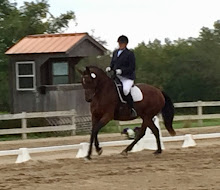
Dressage is complicated that is for sure. I think sometimes we lose track of the basic knowledge we expect from our horses and people just getting started.
Last weekend, we had a Parelli Ground games day at Hay River Equestrian. We raised $150 for the Dunn County Humane Society and had a great time.
Ground games seem like a simple concept - but it sure did bring some things to light. Watching people play ground games with their horses is like a window to their personality. You can really see how people think and learn.
Parelli games are a process learning games that teach horse owners feel. The people that had the hardest time with the games were the feel based learners. The ones that learn through feel and develop their process from there. The folks that had the easiest time were the ones that lean through process and develop their feel from the process. Neither learning style is wrong, just different. Then of course there were the lucky folks who learn easily through process or feel. Those folks seem to be able to adapt to anything.
Learning style aside, it is just good horsemanship to have more influence on the ground. It is really quite helpful to be able to place the horse where you want it. The other thing you can learn from ground games is where your horse is stiff or stuck before you ever ride him. The porcupine game and the driving game really can illuminate a part of the horse that is tight or stuck.
Anyone who is handling horses can benefit from having more influence on the ground. It makes the interaction more interesting, fun and safe.
Sunday, February 26, 2012

Tuesday, December 13, 2011
Get your balance and Keep it!
I have been taking several clinics with Lientje Schueler, which has really made a difference in my riding.
I have had over the years a global problem asking my horses to go into an uphill frame and to stay there. I see many horses at horse shows with flat backs and high necks doing all of the movements but in a really stiff way. I know I have always hesitated to push my horses past where the point that I lose the feeling of their back swinging. I have always felt that an uphill balance with a frozen back is not what I am looking for. It turns out I was right but had no idea how to get uphill without losing the swing of the horse's back.
Many clinicians have you force the horse to work uphill - but then you get an inactive back in your horse. Others never try to help you with longitudinal balance because it is simply too hard. Lientje has step by step process on how to keep the topline relaxed while riding your horse in an uphill dressage balance.
Step one is to be able to push the haunches in whenever you want to and whenever you need to. This needs to be there not because it is the fix but because it supports the solution.
Step two is to ask the horse to move its shoulders to the outside of the circle and flex the neck at will. (Note that if you nave no influence on the haunches - they will just sneak to the outside of the circle.) Another part of step two is to be able to move the shoulders to the inside of the circle at will. Note that in this situation the rider must still be able to hold the haunches where they are needed.
I was doing 1/2 pass in my last lesson in the trot and we played with speeding up the shoulders or slowing them down. (In the past I just stabilized the shoulder and adjusted the haunches.) The ability to ride more lateral flexibility into the shoulders allows the horse to have a more supple topline overall. WOW!
The horse I have been riding has a very good trot and I seem to be able to teach her about collection there and then transfer it to the canter. For example, she is willing to Piaffe and that helps her understand that she needs to use her belly for collection. Anything you can get your horse to understand in one gait will help the other gaits.
The two most important things, teach them in the gait where they can hear you the best and very importantly, find a way to access the lateral flexibility of the shoulder!
Have a great ride every time!
I have had over the years a global problem asking my horses to go into an uphill frame and to stay there. I see many horses at horse shows with flat backs and high necks doing all of the movements but in a really stiff way. I know I have always hesitated to push my horses past where the point that I lose the feeling of their back swinging. I have always felt that an uphill balance with a frozen back is not what I am looking for. It turns out I was right but had no idea how to get uphill without losing the swing of the horse's back.
Many clinicians have you force the horse to work uphill - but then you get an inactive back in your horse. Others never try to help you with longitudinal balance because it is simply too hard. Lientje has step by step process on how to keep the topline relaxed while riding your horse in an uphill dressage balance.
Step one is to be able to push the haunches in whenever you want to and whenever you need to. This needs to be there not because it is the fix but because it supports the solution.
Step two is to ask the horse to move its shoulders to the outside of the circle and flex the neck at will. (Note that if you nave no influence on the haunches - they will just sneak to the outside of the circle.) Another part of step two is to be able to move the shoulders to the inside of the circle at will. Note that in this situation the rider must still be able to hold the haunches where they are needed.
I was doing 1/2 pass in my last lesson in the trot and we played with speeding up the shoulders or slowing them down. (In the past I just stabilized the shoulder and adjusted the haunches.) The ability to ride more lateral flexibility into the shoulders allows the horse to have a more supple topline overall. WOW!
The horse I have been riding has a very good trot and I seem to be able to teach her about collection there and then transfer it to the canter. For example, she is willing to Piaffe and that helps her understand that she needs to use her belly for collection. Anything you can get your horse to understand in one gait will help the other gaits.
The two most important things, teach them in the gait where they can hear you the best and very importantly, find a way to access the lateral flexibility of the shoulder!
Have a great ride every time!
Friday, December 9, 2011
What is nagging and what is overcorrecting?
I teach a lot and I had a student say she did not want to nag her horse. What is the difference between nagging and correcting your horse?
Nagging is a funny word, not one I usually use. I usually say the hardest working rider is the one that corrects just under the amount required to make a change in the horse. This is usually done by someone who is a little more sensitive than their horse. Once the rider understands that the sensitivity of the ride is determined by the sensitivity of the horse, they usually increase their correction to an appropriate level.
Over correcting is a problem with some riders as well. This is the rider who wants respect and they want it now. There is no discussion and that is final. The problem is that the horse will do what is asked of him or her but they end up looking mechanical and dead in their eyes. That is not really what we are after either.
The rider who makes appropriate corrections is the rider who uses enough correction to get the job done but does it in a conversational way. Basically telling the horse he or she is not trying enough and they should consider using themselves a little more. For example an assertive rider will touch lightly with the whip and if no response is felt will go to a medium touch before going further up the scale. In this way the horse knows he or she needs to try harder but is not afraid of the rider.
Sometimes we see very skilled riders coming in with very hard corrections. When they do this most of the time and their horses look mechanical at best. If the rider is very skilled. they may do the requirements very well but their horse never seems to enjoy their job. The advanced riders have a huge responsibility to correct in a proper amount. The beginning and intermediate riders copy your behavior.
Have a great ride every time - both rider and the horse!
Nagging is a funny word, not one I usually use. I usually say the hardest working rider is the one that corrects just under the amount required to make a change in the horse. This is usually done by someone who is a little more sensitive than their horse. Once the rider understands that the sensitivity of the ride is determined by the sensitivity of the horse, they usually increase their correction to an appropriate level.
Over correcting is a problem with some riders as well. This is the rider who wants respect and they want it now. There is no discussion and that is final. The problem is that the horse will do what is asked of him or her but they end up looking mechanical and dead in their eyes. That is not really what we are after either.
The rider who makes appropriate corrections is the rider who uses enough correction to get the job done but does it in a conversational way. Basically telling the horse he or she is not trying enough and they should consider using themselves a little more. For example an assertive rider will touch lightly with the whip and if no response is felt will go to a medium touch before going further up the scale. In this way the horse knows he or she needs to try harder but is not afraid of the rider.
Sometimes we see very skilled riders coming in with very hard corrections. When they do this most of the time and their horses look mechanical at best. If the rider is very skilled. they may do the requirements very well but their horse never seems to enjoy their job. The advanced riders have a huge responsibility to correct in a proper amount. The beginning and intermediate riders copy your behavior.
Have a great ride every time - both rider and the horse!
Tuesday, October 11, 2011
Flying changes for stocky horses
I have always felt more comfortable doing flying changes on my warmbloods. They have a flexibility about them that makes that movement very easy for them provided they are properly aligned.
I always have had a little more trouble with the stockier horses getting them to change leads properly and cleanly. I have been taking several clinics this year and made a point to take a stocky mare that was ready to start her changes.
In preparation for changes I really showed the mare how to narrow the base of her shoulder so that she could carry herself better and swing through and have an uphill balance. Many stocky horses are quite base wide in the shoulder and this causes trouble in the flying change. It seemed like the best way to narrow the base of the shoulder was to do haunches in with my whip in the inside rein and use it at the shoulder is she became wide in front. If you are not sure if your horse is base wide in the shoulder, try increasing the bend a little within a haunches in or half pass. If this is hard, then the shoulders probably are a bit wide. Just work to get a little better bend and this will help.
The horse I was riding in the clinics liked to carry her haunches to the right all of the time a little bit. This caused problems in the flying change too. So the haunches needed to be aligned before a proper change could occur. It the trot I would do renvers into shoulder in to help solve this.
In the canter when the rider is ready to do the flying change, the rider must align the horse. When traveling right to left lead, the haunches had to be pushed to the left and the shoulder moved to the right and then ask for the change. This required me to keep close track of my canter alignment and have a better diagonal connection.
In the canter left to right I just had to ride a little shoulder in to the right to get the right hind under the horse and then the change could come through easily.
Figure out any lateral imbalance in your stocky horse and you will have better flying changes.
Good Luck and have a great ride every day!
I always have had a little more trouble with the stockier horses getting them to change leads properly and cleanly. I have been taking several clinics this year and made a point to take a stocky mare that was ready to start her changes.
In preparation for changes I really showed the mare how to narrow the base of her shoulder so that she could carry herself better and swing through and have an uphill balance. Many stocky horses are quite base wide in the shoulder and this causes trouble in the flying change. It seemed like the best way to narrow the base of the shoulder was to do haunches in with my whip in the inside rein and use it at the shoulder is she became wide in front. If you are not sure if your horse is base wide in the shoulder, try increasing the bend a little within a haunches in or half pass. If this is hard, then the shoulders probably are a bit wide. Just work to get a little better bend and this will help.
The horse I was riding in the clinics liked to carry her haunches to the right all of the time a little bit. This caused problems in the flying change too. So the haunches needed to be aligned before a proper change could occur. It the trot I would do renvers into shoulder in to help solve this.
In the canter when the rider is ready to do the flying change, the rider must align the horse. When traveling right to left lead, the haunches had to be pushed to the left and the shoulder moved to the right and then ask for the change. This required me to keep close track of my canter alignment and have a better diagonal connection.
In the canter left to right I just had to ride a little shoulder in to the right to get the right hind under the horse and then the change could come through easily.
Figure out any lateral imbalance in your stocky horse and you will have better flying changes.
Good Luck and have a great ride every day!
Tuesday, September 27, 2011
Quadrille - What is it? Why do it?
Quadrille is most simply defined as team riding. Riding as a team is great for green horses and riders and can get horses and riders used to showing without the high pressure of showing. There are no qualifying requirements to show quadrille and no non-member fees.
If your quadrille team chooses to show there are tests ranging from basic through third level on the USDF website. The quadrille teams in these tests will consist of four riders. Each team will ride the same test and be compared against each other on cohesiveness and spacing (both longitudinally and laterally). This is a more formal type of quadrille.
Many folks put together quadrille teams for exhibition. These can be 4,6,8 or 12 members. Many exhibition teams are more freestyle in nature and put to music. These freestyle quadrilles are what we do at Hay River Equestrian. We really try to make it fun and help our horses are riders get comfortable in a busier environment.
Our farm is putting on a 6 horse freestyle quadrille at the MN Equifest on 10-15 and 10-16. I hope to see some of you there.
Enjoy every ride every time!
If your quadrille team chooses to show there are tests ranging from basic through third level on the USDF website. The quadrille teams in these tests will consist of four riders. Each team will ride the same test and be compared against each other on cohesiveness and spacing (both longitudinally and laterally). This is a more formal type of quadrille.
Many folks put together quadrille teams for exhibition. These can be 4,6,8 or 12 members. Many exhibition teams are more freestyle in nature and put to music. These freestyle quadrilles are what we do at Hay River Equestrian. We really try to make it fun and help our horses are riders get comfortable in a busier environment.
Our farm is putting on a 6 horse freestyle quadrille at the MN Equifest on 10-15 and 10-16. I hope to see some of you there.
Enjoy every ride every time!
Tuesday, August 23, 2011
The New Era of Musical Rides - Otter Creek Farm
Last weekend I attended a horse show with Amedeus and Hazel. Both horses were very good and did very well. I was so proud of them both!
Otter Creek Farm was a great place to get out and show off their training. The weather was fabulous and the hosts were welcoming.
I learned something this time about musical freestyle. I previously thought that making a pleasant pretty ride showing off your horse's best attributes at each level was the way to go. Don't get me wrong, I still think that. But I have also come to learn that your score goes up when you increase the degree of difficulty. I guess I always kind of knew that but it seems even more important than ever.
The rules have changed in musical freestyle and you are now allowed to do some things above your level of freestyle. This was clearly forbidden before. This makes for an interesting change and a little confusion at first. I am pretty sure I get it and am on board!
Have a great ride every ride!
Otter Creek Farm was a great place to get out and show off their training. The weather was fabulous and the hosts were welcoming.
I learned something this time about musical freestyle. I previously thought that making a pleasant pretty ride showing off your horse's best attributes at each level was the way to go. Don't get me wrong, I still think that. But I have also come to learn that your score goes up when you increase the degree of difficulty. I guess I always kind of knew that but it seems even more important than ever.
The rules have changed in musical freestyle and you are now allowed to do some things above your level of freestyle. This was clearly forbidden before. This makes for an interesting change and a little confusion at first. I am pretty sure I get it and am on board!
Have a great ride every ride!
Tuesday, August 9, 2011
Musical Dressage is great fun!
August should be called the month of the musical rides around here. There are two events coming up that are requiring the creativity of putting together a musical ride. The first is a formal dressage competition at Otter Creek Farm in Wheeler on August 20th and 21st. Humble Hazel is going to do her first competitive musical ride. She will be doing a 1st level Kur.
The next is the West Central Roundup in Glenwood City, WI on August 27th. There Hazel and Amore are going to do a musical ride together. I chose these two because they are rescue horses from Trempealeau County and are just regular horses. I think sometimes people think that dressage is only for warmbloods, Hazel and Amore help people understand - dressage is for every horse.
Hazel is also going to be an advanced horsemanship demo horse in Glenwood City.
 I am going to attempt to attach a photo to this blog so you can see Hazel and Amore getting used to each other to help their musical ride go smoothly.
The next is the West Central Roundup in Glenwood City, WI on August 27th. There Hazel and Amore are going to do a musical ride together. I chose these two because they are rescue horses from Trempealeau County and are just regular horses. I think sometimes people think that dressage is only for warmbloods, Hazel and Amore help people understand - dressage is for every horse.
Hazel is also going to be an advanced horsemanship demo horse in Glenwood City.

Subscribe to:
Posts (Atom)