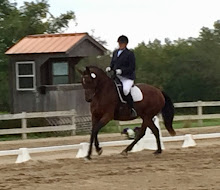
Riding inside the muscle of the horse is a concept that is very hard to explain but very worth taking the time to learn how to do. When you ride if your lower body from your hips down is a part of the horse's barrel - a continuation really, then you are in a position to ride inside the horse's muscle.
It takes much more than a quiet seat, it takes blending of the aids to ride inside the horse. The first part of my journey to ride inside of the muscle started at Charles deKunfy clinics. In those clinics we were riding advanced movements , extensions, flying changes, canter pirouettes, and passage with no stirrups. This made me really good at feeling the muscle of the horse and predicting movement as a result of what I was feeling. I will always be grateful for this information. The other thing that was talked about rather at length was isometric stiffness. What that means is controlling the upper body enough that as a rider your upper body was quiet.
Now years later I think I have a better understanding of riding inside the muscle. I think it includes the blending of the lower body being so close to the horse you can feel the muscles changing. The rider must be willing to use the legs to affect lateral balance and understand how to blend the leg aids with torso control and the rein aids.
The key to riding with great feel is to know how to blend the above and what combinations of blending are required to solve what is going on underneath the rider. I wish someone could have explained that to me as a younger rider but I am also thankful for the people who have been giving that information to me over the years in pieces.
Lunge line lessons are a great help and can move that process along faster. Slow down folks and invest in some lunge line lessons. Riding inside the muscle is hard. Performing the advanced dressage movements is way easier. If you want to do it with elegance, work on yourself. Your horse will thank you and ultimately progress faster.
Tuesday, March 15, 2011

Sunday, March 13, 2011
Goodbye Can Be a Great New Beginning
Today I sold a horse called Shrek but I think he is going to get a new name "Snickers". He is a 10 year old gelding that is a great guy that knows basic dressage. He is super honest and loves attention. His new owner "Sarah" is so excited and I am excited for her. I think they are going to have a great time growing together.
Congrats Sarah and Snickers, best wishes for a great 2011!
Congrats Sarah and Snickers, best wishes for a great 2011!
Saturday, February 12, 2011
Shoulder Influence - you can't ride well without it.
Shoulder influence is not talked about very often but really should be.
In the most basic way the ability to influence the shoulder is required to be sure you can ride your horse on purpose from point A to point B. And maybe it would be easier to think of shoulder influence as front end influence.
When riding the horse it should be evenly bent from the tail to the ears. When you are riding that can be really hard to judge. The most common mistake is not having influence on the horse's neck or shoulder area. The horse either over bends its neck to the inside or counter bends.
If the horse overbends to the inside, it will feel like its shoulder is stuck on the wall and you will have a harder time starting a circle. On the otherhand if the horse is carrying his neck to the outside the rider will talk about the horse falling in on their inside leg.
I have actually stoped asking riders to bend the horse's neck. I have actually started asking them to flex the horses neck (about 1") and then if they need to turn the horse's front end to move both reins with equal pressure to the direction they would like to move the horse. This really helps if the rider then also pushes the horse with their legs. Really the reins act as a frame in and the legs push the horse into the frame the reins have established.
If a rider overbends the horse to the inside or counterbends the horse to the outside the shoulder is free to do whatever it wants and more often than not - the shoulder blocks the goal of the rider.
The hint is ride the whole front end of the horse for better shoulder influence!
Enjoy your horse every single ride!
In the most basic way the ability to influence the shoulder is required to be sure you can ride your horse on purpose from point A to point B. And maybe it would be easier to think of shoulder influence as front end influence.
When riding the horse it should be evenly bent from the tail to the ears. When you are riding that can be really hard to judge. The most common mistake is not having influence on the horse's neck or shoulder area. The horse either over bends its neck to the inside or counter bends.
If the horse overbends to the inside, it will feel like its shoulder is stuck on the wall and you will have a harder time starting a circle. On the otherhand if the horse is carrying his neck to the outside the rider will talk about the horse falling in on their inside leg.
I have actually stoped asking riders to bend the horse's neck. I have actually started asking them to flex the horses neck (about 1") and then if they need to turn the horse's front end to move both reins with equal pressure to the direction they would like to move the horse. This really helps if the rider then also pushes the horse with their legs. Really the reins act as a frame in and the legs push the horse into the frame the reins have established.
If a rider overbends the horse to the inside or counterbends the horse to the outside the shoulder is free to do whatever it wants and more often than not - the shoulder blocks the goal of the rider.
The hint is ride the whole front end of the horse for better shoulder influence!
Enjoy your horse every single ride!
Sunday, January 23, 2011
Saddle Fit Issues May Look Like Training Issues
Training young horses is challanging for sure but the most challanging part about it is that as they build muscle and change shape they can have saddle fitting issues that creep into your everyday riding. A young horse has basic muscle but nothing added from riding which can significanlty change the shape of their backs.
Timid horses that are starting to have trouble with their saddles may want to run away from the aids or buck and brave alpha type horses may have trouble focusing and start acting pushy. The changes can appear gradually but once you notice the change, take a good look at saddle fit right away. The saddle you started with may no longer be appropriate.
Dressage saddles that are made to a specific horse in a custom fashion still need to be monitored. Even if your horse stays somewhat the same shape, as the saddle ages the stuffing can change and become hard and inflexible. So having your saddle restuffed and reshaped to your horse's b ack can be invaluable.
Our horses are generous and want to please us. Lets make it easy for them! Happy riding!
Karen
Timid horses that are starting to have trouble with their saddles may want to run away from the aids or buck and brave alpha type horses may have trouble focusing and start acting pushy. The changes can appear gradually but once you notice the change, take a good look at saddle fit right away. The saddle you started with may no longer be appropriate.
Dressage saddles that are made to a specific horse in a custom fashion still need to be monitored. Even if your horse stays somewhat the same shape, as the saddle ages the stuffing can change and become hard and inflexible. So having your saddle restuffed and reshaped to your horse's b ack can be invaluable.
Our horses are generous and want to please us. Lets make it easy for them! Happy riding!
Karen
Saturday, January 1, 2011
Happy NewYear! Riding resolutions!
Welcome to 2011. January 1st is a time for new years resolutions. This is the day I ask myself what I resolve to do and follow up on with riding goals.
What are your riding goals? Sometimes it is really hard if you just have long term goals and do not break the long term goals down into short term goals. One of the largest pitfalls is to set a goal that is too large and takes too long to obtain. If you do that the goal may seem too overwhelming and may not get done.
Keep your goals attainable and fun for both you and your horse. Remember to have a great time while you work towards your goals.
One of my goals this winter has been to help my dressage horses relax in their work. I have several obstacles in my arena I use on a regular basis. This is so not dressage like but sure does seem to make a difference in the horse having confidence when faced with something unexpected.
O.K. I am off to pencil in the clinic and show schedule for the year.
Happy New Year!
Karen
What are your riding goals? Sometimes it is really hard if you just have long term goals and do not break the long term goals down into short term goals. One of the largest pitfalls is to set a goal that is too large and takes too long to obtain. If you do that the goal may seem too overwhelming and may not get done.
Keep your goals attainable and fun for both you and your horse. Remember to have a great time while you work towards your goals.
One of my goals this winter has been to help my dressage horses relax in their work. I have several obstacles in my arena I use on a regular basis. This is so not dressage like but sure does seem to make a difference in the horse having confidence when faced with something unexpected.
O.K. I am off to pencil in the clinic and show schedule for the year.
Happy New Year!
Karen
Sunday, November 28, 2010
Rescue Horses - A difficult rewarding experience
In June of 2008 I was involved in a rescue operation that was so large that it involved three Wisconsin Rescues. Midwest Horse Welfare Foundation, St. Francis Rescue and Retirement and Refuge Farms. I had not done anything charitable for a while - so I decided to help. Well what a ride it turned out to be.
Hazel and Amore became permanent residents at Hay River Equestrian. Both horses were unhandled and unhaltered adult horses at the time of their adoption. This made it pretty hard to start. I decided both horses would have to be started with food as a bribe. I decided this because it would have been impossible to even try to halter them without grain. Both horses became gentle enough to be touched on their heads while eating and then eventually allowed halters to be slipped over their heads. They were so big and strong that they learned how to lead by following the grain. I would apply halter pressure and if they walked forward and released the pressure, they were allowed a bite of grain. I did it this way because I thought it would be safer than making them stand tied with no knowledge of how to release halter pressure.
They were both very smart and caught on fairly quickly.
Amore was less worried about being touched and allowed us to carefully start petting and touching him farther back on his body and then legs with very little trouble. Hazel was terrified of being touched and could be dangerous if you stood past her shoulder. So many hours went into touching her so she could understand that touch was not so bad. It took using fat soft ropes though to go around Hazel's hind leg so I could pick it up and stroke her leg safely. It took months for me to be able to pick out her hind feet. But it took a whole year before the farrier could trim her hind legs.
Both horses were with me for a year before they were ready to be trained to be riding horses. My friend Pam and I worked with them together until they would take saddles and learned basic lunging. Let me say that they were so scared at times that I had to be on full altert and very awake to be sure I did not get hurt while introducing them to new things. Amore was much more afraid of the saddle than Hazel. Hazel was scared of living things and Amore was afraid of inanimate things. This basic training was the most difficult time I have ever had with ground work. But when I say ground work, what I really mean is I had to change their reality of people and that is why it took so long.
Then I had a young trainer do the initial riding on them and in 2010 they were shown at horse shows. It was quite a reward to see them go to shows and act like well adjusted horses.
It does sadden me that there were 27 horses in this rescue in 2008 and to my knowledge only three of them are riding horses. The two here and one in Milwaukee WI. I now wonder with a 10% rehab rate into riding horses what could have been done differently? How can the rescues get a higher rehab rate? I think that most of these horses were basically healthy and had rehab potential. The biggest issue in my mind is rehab. The rescues do well at saving them - but then what?
Karen
Hazel and Amore became permanent residents at Hay River Equestrian. Both horses were unhandled and unhaltered adult horses at the time of their adoption. This made it pretty hard to start. I decided both horses would have to be started with food as a bribe. I decided this because it would have been impossible to even try to halter them without grain. Both horses became gentle enough to be touched on their heads while eating and then eventually allowed halters to be slipped over their heads. They were so big and strong that they learned how to lead by following the grain. I would apply halter pressure and if they walked forward and released the pressure, they were allowed a bite of grain. I did it this way because I thought it would be safer than making them stand tied with no knowledge of how to release halter pressure.
They were both very smart and caught on fairly quickly.
Amore was less worried about being touched and allowed us to carefully start petting and touching him farther back on his body and then legs with very little trouble. Hazel was terrified of being touched and could be dangerous if you stood past her shoulder. So many hours went into touching her so she could understand that touch was not so bad. It took using fat soft ropes though to go around Hazel's hind leg so I could pick it up and stroke her leg safely. It took months for me to be able to pick out her hind feet. But it took a whole year before the farrier could trim her hind legs.
Both horses were with me for a year before they were ready to be trained to be riding horses. My friend Pam and I worked with them together until they would take saddles and learned basic lunging. Let me say that they were so scared at times that I had to be on full altert and very awake to be sure I did not get hurt while introducing them to new things. Amore was much more afraid of the saddle than Hazel. Hazel was scared of living things and Amore was afraid of inanimate things. This basic training was the most difficult time I have ever had with ground work. But when I say ground work, what I really mean is I had to change their reality of people and that is why it took so long.
Then I had a young trainer do the initial riding on them and in 2010 they were shown at horse shows. It was quite a reward to see them go to shows and act like well adjusted horses.
It does sadden me that there were 27 horses in this rescue in 2008 and to my knowledge only three of them are riding horses. The two here and one in Milwaukee WI. I now wonder with a 10% rehab rate into riding horses what could have been done differently? How can the rescues get a higher rehab rate? I think that most of these horses were basically healthy and had rehab potential. The biggest issue in my mind is rehab. The rescues do well at saving them - but then what?
Karen
Tuesday, August 17, 2010
Horses Engage From The Back To The Front
I recently had an interesting experience. I watched a horse get trained for the period of three months. This horse hated being touched in the rein and was difficult that way. After some experimentation the horse prefered a nickel free bit. This helped somewhat but she still had a significant problem when asked to bend while traveling to the right.
The rider after switching bits just decided not to touch her and keep her happy. But the correct way to engage a horse is to have the energy come from behind and then guide the energy with the reins. This helps the horse relax and build top line and flexibility. When the rider was asked one day to ride the horse forward into the bridle the horse acted stressed out and refused to go and bend. When this happens it is time to check the teeth for a possible floating issue. The horse was floated and she had three year old molars that were in the process of coming off. She had scrapes inside her mouth from this. If the rider would have ridden the horse forward into a little contact, this problem could have been identified and solved right away and the horse would not had to have had so much discomfort.
If you are riding your horse correctly and you encounter a problem. Please take note and look for a physical problem. The worst thing you can do is pacify the horse and possibly cause more discomfort accidentally.
Karen
The rider after switching bits just decided not to touch her and keep her happy. But the correct way to engage a horse is to have the energy come from behind and then guide the energy with the reins. This helps the horse relax and build top line and flexibility. When the rider was asked one day to ride the horse forward into the bridle the horse acted stressed out and refused to go and bend. When this happens it is time to check the teeth for a possible floating issue. The horse was floated and she had three year old molars that were in the process of coming off. She had scrapes inside her mouth from this. If the rider would have ridden the horse forward into a little contact, this problem could have been identified and solved right away and the horse would not had to have had so much discomfort.
If you are riding your horse correctly and you encounter a problem. Please take note and look for a physical problem. The worst thing you can do is pacify the horse and possibly cause more discomfort accidentally.
Karen
Subscribe to:
Posts (Atom)